Friday, 19 July 2013

Statistically interesting problems: correction methods in homogenization

This is the last post in a series on five statistically interesting problems in the homogenization of climate network data. This post will discuss two problems around the correction methods used in homogenization. Especially the correction of daily data is becoming an increasingly important problem because more and more climatologist work with daily climate data. The main added value of daily data is that you can study climatic changes in the probability distribution, which necessitates studying the non-climatic factors (inhomogeneities) as well. This is thus a pressing, but also a difficult task.

The five main statistical problems are:
Problem 1. The inhomogeneous reference problem
Neighboring stations are typically used as reference. Homogenization methods should take into account that this reference is also inhomogeneous
Problem 2. The multiple breakpoint problem
A longer climate series will typically contain more than one break. Methods designed to take this into account are more accurate as ad-hoc solutions based single breakpoint methods
Problem 3. Computing uncertainties
We do know about the remaining uncertainties of homogenized data in general, but need methods to estimate the uncertainties for a specific dataset or station
Problem 4. Correction as model selection problem
We need objective selection methods for the best correction model to be used
Problem 5. Deterministic or stochastic corrections?
Current correction methods are deterministic. A stochastic approach would be more elegant

Problem 4. Correction as model selection problem

The number of degrees of freedom (DOF) of the various correction methods varies widely. From just one degree of freedom for annual corrections of the means, to 12 degrees of freedom for monthly correction of the means, to 120 for decile corrections (for the higher order moment method (HOM) for daily data, Della-Marta & Wanner, 2006) applied to every month, to a large number of DOF for quantile or percentile matching.

What is the best correction method depends on the characteristics of the inhomogeneity. For a calibration problem just the annual mean would be sufficient, for a serious exposure problem (e.g. insolation of the instrument) a seasonal cycle in the monthly corrections may be expected and the full distribution of the daily temperatures may need to be adjusted.

The best correction method also depends on the reference. Whether the variables of a certain correction model can be reliably estimated depends on how well-correlated the neighboring reference stations are.

Currently climatologists choose their correction method mainly subjectively. For precipitation annual correction are typically applied and for temperature monthly correction are typical. The HOME benchmarking study showed these are good choices. For example, an experimental contribution correcting precipitation on a monthly scale had a larger error as the same method applied on the annual scale because the data did not allow for an accurate estimation of 12 monthly correction constants.

One correction method is typically applied to the entire regional network, while the optimal correction method will depend on the characteristics of each individual break and on the quality of the reference. These will vary from station to station and from break to break. Especially in global studies, the number of stations in a region and thus the signal to noise ratio varies widely and one fixed choice is likely suboptimal. Studying which correction method is optimal for every break is much work for manual methods, instead we should work on automatic correction methods that objectively select the optimal correction method, e.g., using an information criterion. As far as I know, no one works on this yet.

Problem 5. Deterministic or stochastic corrections?

Annual and monthly data is normally used to study trends and variability in the mean state of the atmosphere. Consequently, typically only the mean is adjusted by homogenization. Daily data, on the other hand is used to study climatic changes in weather variability, severe weather and extremes. Consequently, not only the mean should be corrected, but the full probability distribution describing the variability of the weather.

Monday, 15 July 2013

WUWT not interested in my slanted opinion

Today Watts Up With That has a guest post by Dr. Matt Ridley. In this post he seems to refer to a story that was debunked more than a year ago:
And this is even before you take into account the exaggeration that seemed to contaminate the surface temperature records in the latter part of the 20th century – because of urbanisation, selective closure of weather stations and unexplained “adjustments”. Two Greek scientists recently calculated that for 67 per cent of 181 globally distributed weather stations they examined, adjustments had raised the temperature trend, so they almost halved their estimate of the actual warming that happened in the later 20th century.
I tried to direct those WUWT readers that are interested in both sides of the conversation to an old post of mine about why these Greek scientist were wrong and mainly how their study was abused and exaggerated by WUWT.

Naturally, I did not formulate it that way, but in a perfectly neutral way suggested that people could find more information about the above quote as my blog. I see no way my comment could have gone against the WUWT commenting policy. Still the response was:

[sorry, but we aren't interested in your slanted opinion - mod]

Strange, people calling themselves skeptics that are not interested in hearing all sides. I see that some people from WUWT still find their way here to see what the moderator does not allow. Here it is:

Investigation of methods for hydroclimatic data homogenization

(I may remove this redirect in some days, as this post does not really provide any new information.)


UPDATE: Sou at Hotwhopper wrote a post, WUWT comes right out and says "We Aren't Interested" in facts , about his post. Thank you, Sou. So I guess I will have to keep this post up. And that also makes it worthwhile to add another gem to be found in the WUWT guest post of Dr. Matt Ridley.

Wednesday, 10 July 2013

Statistical problems: The multiple breakpoint problem in homogenization and remaining uncertainties

This is part two of a series on statistically interesting problems in the homogenization of climate data. The first part was about the inhomogeneous reference problem in relative homogenization. This part will be about two problems: the multiple breakpoint problem and about computing the remaining uncertainties in homogenized data.

I hope that this series can convince statisticians to become (more) active in homogenization of climate data, which provides many interesting problems.

The five main statistical problems are:
Problem 1. The inhomogeneous reference problem
Neighboring stations are typically used as reference. Homogenization methods should take into account that this reference is also inhomogeneous
Problem 2. The multiple breakpoint problem
A longer climate series will typically contain more than one break. Methods designed to take this into account are more accurate as ad-hoc solutions based single breakpoint methods
Problem 3. Computing uncertainties
We do know about the remaining uncertainties of homogenized data in general, but need methods to estimate the uncertainties for a specific dataset or station
Problem 4. Correction as model selection problem
We need objective selection methods for the best correction model to be used
Problem 5. Deterministic or stochastic corrections?
Current correction methods are deterministic. A stochastic approach would be more elegant

Problem 2. The multiple breakpoint problem

For temperature time series about one break per 15 to 20 years is typical. Thus most interesting stations will contain more than one break. Unfortunately, most statistical detection methods have been developed for one break. To use them on series with multiple breaks, one ad-hoc solution is to first split the series at the largest break (for example the standard normalized homogeneity test, SNHT) and investigate the subseries. Such a greedy algorithm does not always find the optimal solution.

Another solution is to detect breaks on short windows. The window should be short enough to contain only one break, which reduces power of detection considerably.

Multiple breakpoint methods can find an optimal solution and are nowadays numerically feasible. Especially using the optimization methods “dynamic programming”. For a certain number of breaks these methods find the break combination that minimize the internal variance, that is variance of the homogeneous subperiods, (or you could also state that the break combination maximizes the variance of the breaks). To find the optimal number of breaks, a penalty is added that increases with the number of breaks. Examples of such methods are PRODIGE (Caussinus & Mestre, 2004) or ACMANT (based on PRODIGE; Domonkos, 2011). In a similar line of research Lu et al. (2010) solved the multiple breakpoint problem using a minimum description length (MDL) based information criterion as penalty function.


This figure shows a screen shot of PRODIGE to homogenize Salzburg with its neighbors (click to enlarge). The neighbors are sorted based on their cross-correlation with Salzburg. The top panel is the difference time series of Salzburg with Kremsmünster, which has a standard deviation of 0.14°C. The middle panel is the difference between Salzburg and München (0.18°C). The lower panel is the difference of Salzburg and Innsbruck (0.29°C). Not having any experience with PRODIGE, I would read this graph as suggesting that Salzburg probably has breaks in 1902, 1938 and 1995. This fits to the station history. In 1903 the station was moved to another school. In 1939 it was relocated to the airport and in 1996 it was moved on the terrain of the airport. The other breaks are not consistently seen in multiple pairs and may thus well be in another station.

Saturday, 6 July 2013

Five statistically interesting problems in homogenization. Part 1. The inhomogeneous reference problem

This is a series I have been wanting to write for a long time. The final push was last week's conference, the 12th International Meeting Statistical Climatology (IMSC), a very interesting meeting with an equal mix of statisticians and climatologists. (The next meeting in three years will be in the area of Vancouver, Canada, highly recommended.)

At the last meeting in Scotland, there were unfortunately no statisticians present in the parallel session on homogenization. This time it was a bit better. Still it seems as if homogenization is not seen as the interesting statistical problem it is. I hope that this post can convince some statisticians to become (more) active in homogenization of climate data, which provides many interesting problems.

As I see it, there are five problems for statisticians to work on. This post discusses the first one. The others will follow the coming days. UPDATE: they are now linked in the list below.
Problem 1. The inhomogeneous reference problem
Neighboring stations are typically used as reference. Homogenization methods should take into account that this reference is also inhomogeneous
Problem 2. The multiple breakpoint problem
A longer climate series will typically contain more than one break. Methods designed to take this into account are more accurate as ad-hoc solutions based single breakpoint methods
Problem 3. Computing uncertainties
We do know about the remaining uncertainties of homogenized data in general, but need methods to estimate the uncertainties for a specific dataset or station
Problem 4. Correction as model selection problem
We need objective selection methods for the best correction model to be used
Problem 5. Deterministic or stochastic corrections?
Current correction methods are deterministic. A stochastic approach would be more elegant

Problem 1. The inhomogeneous reference problem

Relative homogenization

Statisticians often work on absolute homogenization. In climatology relative homogenization methods, which utilize a reference time series, are almost exclusively used. Relative homogenization means comparing a candidate station with multiple neighboring stations (Conrad & Pollack, 1950).

There are two main reasons for using a reference. Firstly, as the weather at two nearby stations is strongly correlated, this can take out a lot of weather noise and make it much easier to see small inhomogeneities. Secondly, it takes out the complicated regional climate signal. Consequently, it becomes a good approximation to assume that the difference time series (candidate minus reference) of two homogeneous stations is just white noise. Any deviation from this can then be considered as inhomogeneity.

The example with three stations below shows that you can see breaks more clearly in a difference time series (it only shows the noise reduction as no nonlinear trend was added). You can see a break in the pairs B-A and in C-A, thus station A likely has the break. This is confirmed by there being no break in the difference time series of C and B. With more pairs such an inference can be made with more confidence. For more graphical examples, see the post Homogenization for Dummies.

Figure 1. The temperature of all three stations. Station A has a break in 1940.
Figure 2. The difference time series of all three pairs of stations.

Monday, 3 June 2013

Reviews Paleofantasy? Maybe eating meat, nuts, fruit and vegetables is okay

Jason Collins has just written a review of Marlene Zuk’s book "Paleofantasy: What Evolution Really Tells Us about Sex, Diet, and How We Live". Having read several reviews of this book, this review sounds like the one I would have written, had I read the book. (I am not the only one; many reviews were written based upon previous articles by Zuk and not based on her book. Jason Collins did read the book.)
... Zuk parades a series of straw men rather than searching for the more sophisticated arguments of Paleo advocates. Many chapters begin with misspelled comments that Zuk found under blog posts. While Zuk shoots the fish in the barrel, the more interesting targets are not addressed.
I had almost chosen as title: debunking a book that promotes a diet full of processed "foods", grains and sugar and warns for a diet of meat, nuts, fruit and vegetables. Fortunately, that super straw man title was too long. This one, Maybe eating meat, nuts, fruit and vegetables is okay, is straw manly enough; it can be hard find a good concise title.

My paleofantasy

To me, paleo is not much more than a productive generator of hypothesis and a good story that helps to bundle several suggests for life-style changes.

Although you can say, that it would be very surprising that a diet humans were eating for a such long time, a time largely without chronic decease, would be unhealthy in this modern age. Not impossible, but you would expect very strong proof, much stronger as, for example, the epidemiological study promoted by T. Colin Campbell in his vegan bible: The China Study.

And the narrative is good enough to encourage people to try a range of different diets and life-style options to see on which one they feel best and not stick to the officially healthy one, if it is not working for them. Just play and experiment, that is what defines us as humans.

Review by Hunt Gather Love

You can go to Hunt Gather Love, for a more technical and intelligent review on Paleofantasy from someone who "wanted to like this book". Another good related post from the same blog: paleo fantasies: Debunking The Carnivore Ape Narrative, makes clear that paleo hypothesis does not prescribe a diet of only meat, nor a low-carb diet.

Sunday, 26 May 2013

Christians on the climate consensus

Dan Kahan thinks that John Cook and colleagues should shut up about the climate consensus; the consensus among climatologists that the Earth is warming and human action is the main cause. Kahan claims that research shows that talking about consensus is:
a style of advocacy that is more likely to intensify opposition ... then [to] ameliorate it
It sounds as if his main argument is that Cook efforts are counter productive because Cook is not an American Republican, which is hard to fix.

Katryn Hayhoe

As an example of how you communicate climate science the right way, Kahan mentions Katryn Hayhoe as an example. Hayhoe is an evangelical climate change researcher and stars in three beautifully made videos where Hayhoe talks about God and climate change.

Except that she also talks about her religion, I personally see no difference with any other message for the general public on climate change. She also openly speaks about the disinformation campaign by the climate ostriches.
The most frustrating thing about her position, she says, is the amount of disinformation which is targeted at her very own Christian community.
Maybe naively, but I was surprised that the Christian community is a special target. While I am not a Christian myself, my mother was a wise environmentally concious woman and a devout Christian. Also when in comes to organized religion, I remember mainly expressions of concern about climate change. Thus I thought that Christians are a positive, maybe even activist, force with respect to climate change.

Thus let's have look what the Christian Churches think about climate change.

Monday, 20 May 2013

On consensus and dissent in science - consensus signals credibility

Since Skeptical Science published the Pac Man of The Consensus Project, the benign word consensus has stirred a surprising amount of controversy. I had already started drafting this post before, as I had noticed that consensus is an abomination to the true climate ostrich. Consensus in this case means that almost all scientists agree that the global temperature is increasing and that human action is the main cause. That the climate ostriches do not like this fact, I can imagine, but acting as if consensus in itself is in bad thing in itself sounds weird to me. Who would be against the consensus that all men have to die?

Also the Greek hydrology professor Demetris Koutsoyiannis echoes this idea and seems to think that consensus is a bad thing (my emphasis):
I also fully agree with your statement. "This [disagreement] is what drives science forward." The latter is an important agreement, given a recent opposite trend, i.e. towards consensus building, which unfortunately has affected climate science (and not only).
So, what is the role of consensus in science? Is it good or bad is it helpful or destructive, should we care at all?

Credibility

In a recent post on the value of peer review for science and the press, I have argued that one should not dramatize the importance of peer review, but that it is a helpful filter to determine which ideas are likely worth studying. A paper which has passed peer review, has some a-priory credibility.

In my view, consensus is very similar, consensus lends an idea credibility. It does not say that an idea is true; if formulating carefully a scientist will never state that something is true, not even about the basics of statistical mechanics or evolution, which are nearly truisms and have been confirmed via many different lines of research.

Wednesday, 15 May 2013

Readership of all major "sceptic" blogs is going down

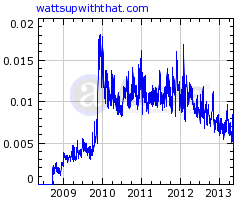
In my first post of this series I showed that the readership of WUWT and Climate Audit has gone down considerably according to social bookmarking site Alexa; see below. (It also showed that the number of comments at WUWT is down by 100 comments a day since beginning 2012.)


reach of WUWT according to Alexa

reach of Climate Audit according to Alexa

I looked a bit further on Alexa and this good news is not limited to these two. All the "sceptics" blogs I knew and had statistics are going down. Bishop Hill, Climate Depot, Global Warming, Judith Curry, Junk Science, Motls, and The Blackboard (Rank exploits) are all going down. Interestingly the curves look very different for every site and unfortunately they show some artificial spikes. Did I miss a well known blog?