Showing posts with label climate ostriches. Show all posts

Sunday, 27 September 2015

AP, how about the term "mitigation sceptic"?


The Associate Press has added an entry into their stylebook on how to address those who reject mainstream climate science. The stylebook provide guidance to the journalists of the news agency, but is also used by many other newspapers. No one has to follow such rules, but journalists and many other writers often follow such style guides for accurate and consistent language. It probably also has an entry on whether you should write stylebook or style book.

The new entry advices to steer clear from the terms "climate sceptic" and "climate change denier", but to use the long form "those who reject mainstream climate science" or if that is too long "climate doubter".

Peter Sinclair just published an interview by the US national public radio (NPR) channel with Associated Press’ Seth Borenstein, who wrote the entry. Peter writes: the sparks are flying. It also sound as if those sparks are read from paper.

How do you call John Christie, a scientists who rejects main stream science? How do you call his colleague Roy Spencer who wrote a book titled: "The Great Global Warming Blunder: How Mother Nature Fooled the World’s Top Climate Scientists." How do you call the Republican US Senator with the snowball, [[James Inhofe]], who wrote a book that climate science is a hoax? How do you call Catholic Republican US Senator [[Paul Gosar]] who did not want to listen to Pope talking about climate change? How do you call Anthony Watts, a blogger who is willing to publish everything he can spin into a story against mitigation and science? How do you call Tim Ball, a retired geography professor who likes to call himself climatology professor, who cites from Mein Kampf to explain that climate science is similar to the Big Lie of the Jewish World Conspiracy.

I would suggest: by their name. If you talk about a specific person, it is best to simply use their name. Most labels are inaccurate for a specific person. If positive we may be happy to accept an inaccurate label. A negative label will naturally be disputed and can normally be disputed.

We are thus not looking for a word for a specific person. We are looking for a term for the political movement that rejects mainstream climate science. I feel it was an enormous strawman of AP's Seth Borenstein to talk about John Christy. He is an enormous outlier, he may reject mainstream science, but as far as I know talks like a scientist. He is not representative of the political movement of Inhofe, Rush Limbaugh and Fox News. Have a look at the main blogs of this political movement: Watts Up With That, Climate Etc., Bishop Hill, Jo Nova. And please do not have a look at the even more disgusting smaller active blogs.

That is the political movement we need a name for. Doubters? That would not be the first term I would think of after some years of participating in this weird climate "debate". If there is one problem with this political movement, it is a lack of doubt. These people are convinced they see obvious mistakes in dozens of scientific problems, which the experts of those fields are unable to see, while they just need to read a few blog posts to get it. If you claim obvious mistakes you have two options: either all scientists are incompetent or they are all in a conspiracy. These are the non-scientists who know better than scientists how science is done. These are the people who understand the teachings of Jesus better than the Pope. Without any doubt.

It would be an enormous step forward in the climate "debate" if these people had some doubts. Then you would be able to talk to them. Then they might also search for information themselves to understand their problems better. Instead they like to call every source of information on mainstream science an activist resource to have an excuse not to try to understand the problem they are not doubting about.

I do think that the guidance of the AP is a big step forwards. It stops the defamation of the term that stands for people who advocate sceptical scientific thinking in every aspect of life. The sceptic organisation the Center for Inquiry has lobbied news organisations for a long time to stop the inappropriate use of the word sceptic. The problems the word doubter has is even more true for the term "sceptic". These people are not sceptical at all, especially they do not question their own ideas.

The style guide of The Guardian and the Observer states:
climate change denier
The [Oxford English Dictionary] defines a sceptic as "a seeker of the truth; an inquirer who has not yet arrived at definite conclusions".

Most so-called "climate change sceptics", in the face of overwhelming scientific evidence, deny that climate change is happening, or is caused by human activity, so denier is a more accurate term
I fully agree with The Guardian and NPR that "climate change denier" is the most accurate term for this group. They will complain about it because it does not put them in a good light. Which is rather ironic because this is the same demographic that normally complains about Political Correctness when asked to use an accurate term rather than a derogatory term.

The typical complaint is that the term climate change deniers associates them with holocaust deniers. I had that association before they said it. They are the group that promotes this association most actively. A denier is naturally simply someone who denies something, typically something that is generally accepted. The word existed long before the holocaust. The Oxford English Dictionary defines a denier as:
A person who denies something, especially someone who refuses to admit the truth of a concept or proposition that is supported by the majority of scientific or historical evidence:
a prominent denier of global warming
a climate change denier
In one-way communication, I see no problem with simply using the most accurate term. When you are talking with someone about climate science, however, I would say it is best to avoid the term. It will be used to talk about semantics rather than about the science and the science is our strong point in this weird climate "debate".

When you talk about climate change in public, you do so for the people who are listening in. That are many more people and they may have an open mind. The best way to show you have science on your side is to stick to one topic and go in depth, define your terms, ask for evidence and try to understand why you disagree. That is also what scientists would do when they disagree. Staying on topic is the best way to demonstrate their ignorance. You will notice that they will try everything to change the topic. Attend your listeners to this behaviour and keep on asking questions about the initial topic. To use the term "denier" would only make it easier for them to change the topic.

An elegant alternative is the term "climate ostrich". With apologies to this wonderful bird, that does not put his head in sand when trouble is in sight, but everyone immediately gets the connection that a climate ostrich is someone who does not see climate change as a problem. When climate ostriches venture out in the real world, they sometimes wrongly claim that no one has ever denied the greenhouse effect, but they are very sure it is not really a problem.

However, I am no longer convinced that everyone in this political movement does not see the problem. Part of this movement may accept the framing of the environmental movement and of development groups that climate change will hit the poor and vulnerable people most and like that a lot. Not everyone has the same values. Wanting to see people of other groups suffer is not a nice thing to say in public. What is socially acceptable in the US is to claim to reject mainstream science.

To also include this fraction, I have switched to the term "mitigation sceptic". If you listen carefully, you will hear that adaptation is no problem for many. The problem is mitigation. Mitigation is a political response to climate change. This term thus automatically makes clear that we are not talking about scientific scepticism, but about political scepticism. The rejection of mainstream science stems from a rejection of the solutions.


I have used "mitigation sceptic" for some time now and it seems to work. They cannot complain about the "sceptic" part. They will not claim to be a fan of mitigation. Only once someone answered that he was in favour of some mitigation policies for other reasons than climate change. But then these are policies to reduce American dependence on the Saudi Arabian torture dictatorship, or policies to reduce air pollution, or policies to reduce unemployment by shifting the tax burden from labour to energy. These may happen to be the same policies, but then they would not be policies to mitigate the impacts of climate change.

Post Scriptum. I will not publish any comments claiming that denier is a reference to the holocaust. No, that is not an infringement of your freedom of speech. You can start your own blog for anyone who wants to read that kind of stuff. That does not include me.

[UPDATE. John Mashey suggests the term "dismissives": Global Warming’s Six Americas 2009 carefully characterized the belief patterns of Americans, which they survey regularly. The two groups Doubtful and Dismissive are different enough to have distinct labels.

Ceist, in a comment suggested: "science rejecters".

Many options, no need for the very inaccurate term "doubter" for people who display no doubt. ]


Related reading


Newsweek: The Real Skeptics Behind the AP Decision to Put an End to the Term 'Climate Skeptics'.

Eli has a post on the topic, not for the faint at heart: Eli Explains It All.

Greg Laden defends Seth Borenstein as an excellent journalist, but also sees no "doubt": Analysis of a recent interview with Seth Borenstein about Doubt cf Denial.

My immature and neurotic fixation on WUWT or how to talk to mitigation sceptics in public.

How to talk to uncle Bob, the climate ostrich or how to talk to mitigation sceptics in your social circles.

Do dissenters like climate change?

Planning for the next Sandy: no relative suffering would be socialist.

Sunday, 28 December 2014

Blog network analysis: WUWT & Co. isolated from science

UPDATE: In retrospect I should have chosen a more careful title.


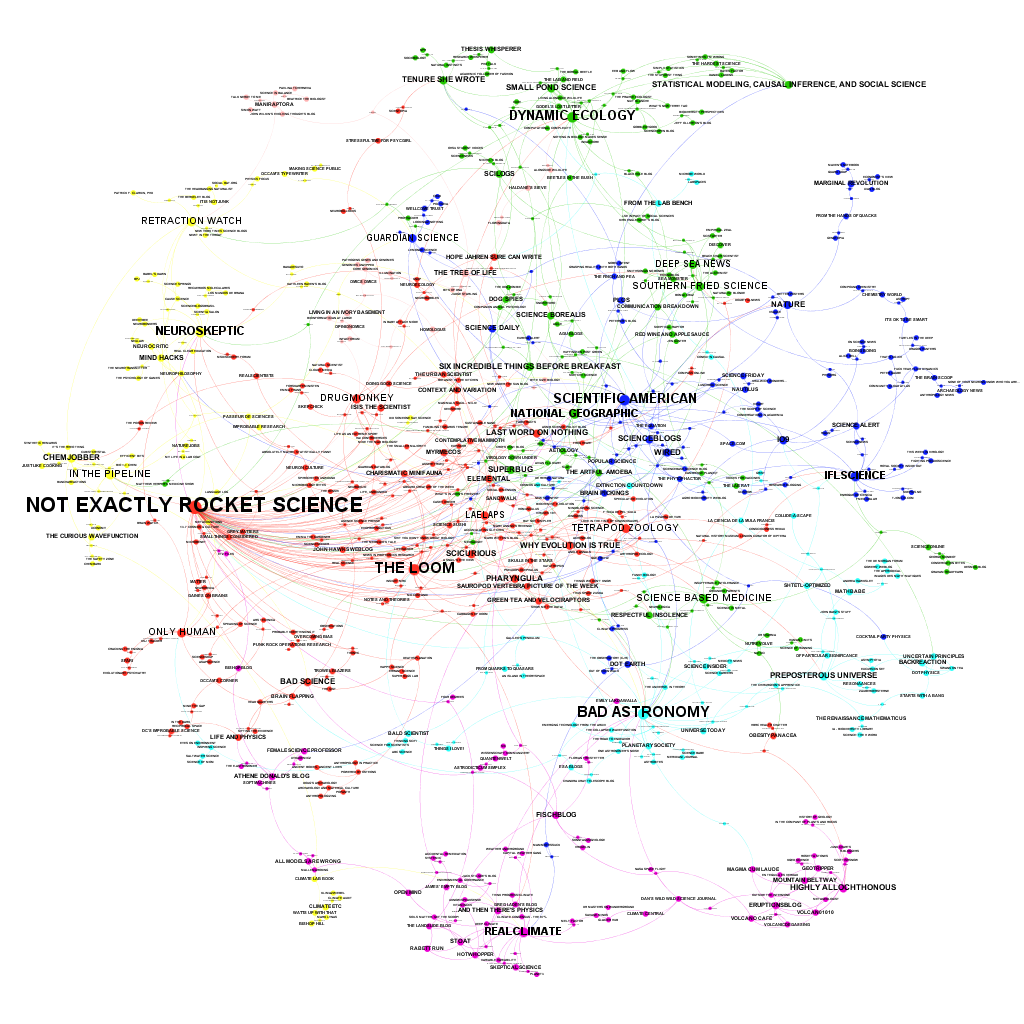
Paige Brown Jarreau performed a survey among science bloggers. A first result is the fascinating network analysis of science blogs shown above. She also published a PDF where you can zoom in to look at the details. The survey asked every blogger to list three other regularly read science blogs. In the figure above the blogs are the dots and every mention is a link between the dots. The more incoming links, the bigger the dot and name. The links do not show in which direction the link runs. The smallest print is for blogs that participated, but have no incoming links.

Clearly dominating is the blog Not Exactly Rocket Science by Ed Young. Also influential is Bad Astronomy by Phil Plait, who also blogs about climate and the "climate debate". Except for these two outliers, the network is surprisingly egalitarian.

There is likely a sampling bias, but the small number of non-english blogs is striking.

For us the climatic part of the blog universe is naturally most interesting.


Here RealClimate clearly dominates. Even if they are not that active anymore and are calling for a new generation of climate scientists to help them continue high-quality climate science blogging.

One should be very careful to interpret the details. My little blog is only more visible than the blog of the more important International Surface Temperature Initiative because I have one incoming link. Such details can thus quickly change when more bloggers had participated or more than 3 blogs could have been mentioned.

Emphasized by the automatic coloring scheme is the splendid yellow isolation of WUWT & Co. If there would be no link between WUWT and the Climate Lab Book, they would have no link to science whatsoever. This network analysis could be used to determine who is eligible for a bloggie in the category science.

[UPDATE 3: The WUWT cluster looks large, it has 8 blogs and many links between them, but this feature is less robust than you would thus think. It is only based on the responses of 3 bloggers. Had I thought of that before, I would have chosen a more careful title.]

Here it should probably be mentioned that a link is not necessarily a recommendation. I know of some US climate scientists that keep an eye on WUWT to know of the latest nonsense story before the journalists start calling. You can be sure that they do not read WUWT to learn about the climate system. The isolation was to be expected given the quality standards at WUWT, which do not fit to science.

On the other hand, the purple climate and geo sciences cluster is clearly well embedded in the scientific community. The blogs Climate Etc. and Klimazwiebel often talk about building bridges to the mitigation sceptics. Maybe they should put a bit more emphasis on building bridges to the scientific community. (And I sometimes wonder why they do not want to build bridges to alarmist activists as well.)

[UPDATE 1: William M. Connolley reports on this post at Stoat and unfortunately emphasizes the presence of Mark Lynas and the Klimazwiebel in the yellow cluster. Both depends on only one link, on only one blogger mentioning them. Such details should not be taken seriously. The yellow cluster having little interaction with science blogs would likely remain if a bigger sample were available, but details about single little-mentioned blogs could completely change.]

More activist blogs, such as Georg Monbiot and Desmog Blog are not in the climate cluster, but can be found on the middle right as a green cluster.

[UPDATE 2: There are now several blog posts on this topic.

Stoat (William M. Connolley) and Climate Etc. (Judith Curry) summarize this post. The comment section at CE is, again, very ugly, full of personal attacks, which is the response of last resort if you do not have any arguments. Fitting to the isolation of the WUWT & Co cluster is that the Stoat post gives me more visitors than the post at Climate Etc. While for a Climate Etc. reader it would make more sense to expect that my post is misrepresented and thus to click on the link to check what was really written. And just like WUWT, Climate Etc. is proud of the large amount of comments and clicks; Judith Curry in 2010: "If what I said was utter nonsense, why is anyone here talking about it, I have 440 comments in 24 hours." If CE is really so big, it certainly has more comments, you would expect more, not less, readers coming from there.

Lucia at The Blackboard reports about the Climate Etc. post with the funny title: HotWhopper’s Sou Doesn’t read WUWT!

A smart observation. Lucia is highly intelligent and a fierce debater. The climate "debate" would be more interesting if she would run WUWT. Unfortunately, she seems to see the climate "debate" as a sport. If she were more interested in improved understanding, I would read her blog often.

While it is a smart observation, the simple reason for the perceive discrepancy may be:


And indeed, Sou from HotWhopper writes (Hat tip Lucia in her comments):
The blog I probably visit most frequently I didn't list - because I don't rate it as a science blog, although I see that it appears on your map.
I mentioned:

And Then There's Physics: A great place for intelligent conversation on climate and the climate debate.

HotWhopper: A good place to keep up to date with what happens at WUWT without having to read the misinformation. Sometimes you do not remember where you got some information from, you might think it was a reliable source, whereas it was WUWT. I already embarrassed myself among colleagues by repeating something I had learned at WUWT and could not imagine being wrong, being so basic, but it was. Best to limit your exposure, to keep your brain healthy.

Real Climate: If there is a new RealClimate post that is likely to be a good investment of my precious life time and I read a large part of them to keep up to date with the state of the art in fields where I do not work on myself.

Lucia also wondered why I did not mention WUWT. I do not know anymore. Maybe because the question was about science blogs and WUWT is a political blog. The reaction of WUWT to a new piece of research can be predicted extremely well by considering whether it makes the political case for mitigation stronger or weaker. On a science blog, the reaction would depend on the quality of the research and whether the conclusions are justified by the evidence presented.

Maybe I also just did not mention WUWT because reading it is not a high priority. But I have never denied reading WUWT occasionally. When I read it, more out of interest as blogger. It is the voice of mainstream mitigation skepticism.

It is probably not a good idea to interpret single links and sizes of blogs. You should probably not even interpret the size of the clusters due inherent problems with sampling and because blogs in the cluster of WUWT & Co might not have seen themselves as the target group.

It is still interesting that the only link between the WUWT & Co. cluster to the rest is Ed Hawkins stating to read WUWT. None of the sampled blogs in the yellow cluster have reported themselves to read blogs outside of their cluster. The "isolation" is, in this respect, self-selected. In this regard, it is somewhat strong that mitigation skeptics complain about me showing this network.

If the sample were bigger, some links may have appeared. And there might be weaker links; had the question asked for a larger list of blogs, these links may have appeared, but the cluster would likely have stayed quite self-referential. I would expect that that part of the network analysis is robust and that is why I emphasized that part.

The survey was about what motives science bloggers. This network is interesting, but "just" a side result that should not be over-interpreted.]


Related reading

A Network of Blogs, Read by Science Bloggers. Here Paige Brown Jarreau (The Lab Bench) explains more details of the network analysis and shows a plot with all the blogs in the purple climate/geo science cluster.

The figures can be found at Figshare.

You can play with this data via an interactive Gephi graphic here: bit.ly/MySciBlogREAD, which also gives you links to the blogs to find new interesting ones.

Stoat: Tee hee

Readership of all major "sceptic" blogs is going down. (WUWT has already removed all independent counters.)

The BBC will continue fake debates on climate science.

Interesting what the interesting Judith Curry finds interesting.

Sunday, 24 August 2014

The Tea Party consensus on man-made global warming

Dan Kahan, Professor of Law and Psychology at Yale, produced a remarkable plot about the attitude towards global warming of Tea Party supporters.

Kahan of the Cultural Cognition Project is best known for his thesis that climate "sceptics" should be protected from the truth and that no one should mention the fact that there is a broad agreement (consensus) under climate scientists that we are changing the climate.

Without having the scientific papers to back it up, reading WUWT and Co. leaves one with the impression that there are many more scientific claims on climate change that would make these "sceptics" more defensive. They may actually be willing to pay not to hear them. We could use the money to stimulate renewable energy; to reduce air pollution in the West naturally, not for mitigation of global warming that would help everyone.

Tea Party

Maybe I should explain for the non-American readers that the Tea Party is a libertarian, populist and conservative political movement against taxes that gained prominence when the first "black" US president was elected.

It is well known that members of the Tea Party are more dismissive of global warming as the rest of the Republicans or Democrats in the USA. It could have been that Tea-Party members are "more Republican" as other people calling themselves Republican. The plot below by Dan Kahan suggests, however, that identifying with the Tea Party is an important additional dimension.

In fact, normal Republicans and democrats are not even that different. The polarization in the USA is to a large part due to the Tea Party. Especially, when you consider that the non-Tea-Party Republicans most to the right of the scale may still have a more tax-libertarian disposition than the ones more in the middle.

For me the most striking part is how sure Tea Party members claim to be that global warming is no problem. On average they see global warming as being a very low risk, the average is a one on a scale from seven to zero. Given how close that average is to the extreme of the scale, there cannot be that much variability. There thus probably is a consensus among Tea Party members that global warning is a low risk. That was something Kahan did not explicitly write in his post.

That is quite a consensus for a position without scientific evidence. I guess we are allowed to call this group think, given that many climate "sceptics" even call a consensus with evidence group think.


Related reading

Real conservatives are conservationists by Barry Bickmore (a conservative).
"The radical libertarians’ knee-jerk rejection of the scientific consensus on climate change isn’t just anti-Conservative. It borders on sociopathy in its extreme anti-intellectualism and recklessness."
The conservative family values of Christian man Anthony Watts
A post on the extremist and anti-intellectual atmosphere at WUWT and Co.
Planning for the next Sandy: no relative suffering would be socialist
Some people seem to be willing to suffer loses as long as others suffer more. This leads to the question: "Do dissenters like climate change?"

Monday, 28 July 2014

Is the US historical network temperature trend too strong?

Climate dissenters often claim that the observed temperature trend is not only due to global warming, but for a large part due to local effects: due to increases in urbanization around the stations or somehow because of bad micro-siting.

A few days ago I had a twitter discussion with Ronan Connolly. He and his father claim that 0.2°C per century of the temperature increase in the USA is due to urbanization and 0.1°C per century is due to micro-siting. That is quite a lot. Together it would be almost half of the temperature trend seen in the main global datasets.


One of the great things of America is that they have a climate reference network (USRCN). The observations are normally made by the meteorologists and contain non-climatic effects that are not relevant for the meteorologists, but they are to climatologists. Thus to track accurately what is happening to the climate, NOAA has set up a climate reference network that follows high climatological standards. The main thing for this post is that these stations are located in pristine locations, without any problems with urbanization and micro-siting.

We only have data from this network starting in 2005. That is only a decade of data, but if the problems with the normal data are as large as Connolly claims, I thought we might be able to see some differences between the reference network and the normal US historical Climate Network (USHCN). In the USHCN non-climatic effects have been removed as well as possible with the pairwise homogenization algorithm (PHA) of NOAA.

The figure of NOAA below (in Fahrenheit) shows that USHCN (normal) and USRCN (reference) track each other quite closely. If you look at the details, you can see that actually the USRCH is a little below USHCN in the beginning and a little above at the end. In other words, the temperatures of the reference network are warming faster than those of the normal network. The opposite of what the climate dissenters would expect.


Let's have a more detailed look at the difference between the two networks in the following graph. It shows that the warming in the reference network was 0.09°C stronger per decade. For comparison with the trend due to global warming, you could also say that it is 0.9°C stronger per century. That is just as much as the observed global warming trend.


That the trend in the normal data is an underestimate of the true warming is no surprise for me. The trend of the raw American data has a strong cooling bias. Removing of non-climatic effects (homogenization) increases the temperature trend since 1880 by 0.4°C. We also know that homogenization can make trend estimates more reliable, but cannot fully remove the bias. Thus it was likely that there was a remaining cooling bias.

The cooling bias could be due to a number of effects. An important cooling bias in the USA is the transition of conventional observations with a cotton region shelter to automatic weather stations (maximum-minimum temperature systems). This transition is almost completed and was more intense in the previous century. Other biases could be the relocation of city stations to airports. This mainly took place before and during the second world war. The increased in interest in climate change may have increased interest in urbanization and micro-siting, which may thus have improved over time due to relocations. (Does anyone know any articles on that? I only know one for Austria.) There is also a marked increase in irrigation of gardens and cropland the last century.

That the effect is this strong is something we should probably not take seriously (yet). We only have nine values and thus a large uncertainty. In addition, homogenization is less powerful near the edges of the data, you want to detect changes in the mean and should thus be able to compute a mean with sufficient accuracy. As a consequence, NOAA does not adjust the last 18 month of the data, while half of the trend is due to the last two values. Still an artificial warming of USHCN, as the climate dissenters claim, seems highly unlikely.

This cooling bias is an interesting finding. Even if we should not take the magnitude too seriously, it shows that we should study cooling biases in the climate observations with much more urgency. The past focus on detecting climate change has led to a focus on warming biases, especially urbanization. Now that that problem is cleared, we need to know the best estimate of the climatic changes and not just the minimum estimate.

Maybe even more importantly, it shows that we need climate reference networks in every country. Especially to study climatic changes in extreme weather in daily station data, data that is much harder to homogenize than the annual means. We are performing a unique experiment with our global climate system. Future scientists will never forgive us if we do not measure what is happening as accurately as we can.

[UPDATE. In case anyone wants to analyse the "dataset", here it is:
diff = [0.017 0.050 0.022 0.017 0.022 0.017 -0.006 -0.039 -0.033]; % Difference USHCN-USRCN in °C
year = 2005:2013;
]

See also

Howard J. Diamond, Thomas R. Karl, Michael A. Palecki, C. Bruce Baker, Jesse E. Bell, Ronald D. Leeper, David R. Easterling, Jay H. Lawrimore, Tilden P. Meyers, Michael R. Helfert, Grant Goodge, Peter W. Thorne, U.S. Climate Reference Network after One Decade of Operations: Status and Assessment, Bulletin of the American Meteorological Society, 2013, 94, 4, 485, doi: 10.1175/BAMS-D-12-00170.1.

Monday, 9 June 2014

My immature and neurotic fixation on WUWT

More neutral titles for this post could have been: "why do I blog about pseudosceptics?" or "how to play climateball(TM) for scientists".

Last week I wrote about the unchristian, indecent, ugly language at WUWT, in my post: The conservative family values of Christian man Anthony Watts. Just a sample: Pathetic whining, creature, sub-human, odious toads, evil, Hitler, Stalin and diseased narcissism (archive).

I just noticed that I had missed an insult by Anthony Watts himself, in his response to my request to remove a comment with the usual pun on my last name.
Looking at how often your cite WUWT in negative connotations, I’d say you have a fixation.
To fully appreciate the insult, you need to clicking on the link to Wikipedia. (Let's ignore the irony of Watts linking to Wikipedia in a post about how unreliable Wikipedia is and how the evil William M. Connolley single handedly turned Wikipedia into an alarmist CAWG propaganda tool. In other words, how Connolley as one of the editors and backed by the scientific literature kept their nonsense to a minimum.) Wikipedia writes about fixation (psychology) (archive):
Fixation is a concept originated by Sigmund Freud (1905) to denote the persistence of anachronistic sexual traits. ... More generally, it is the state in which an individual becomes obsessed with an attachment to another person, being, or object (in human psychology): "A strong attachment to a person or thing, especially such an attachment formed in childhood or infancy and manifested in immature or neurotic behavior that persists throughout life". ... Fixation to intangibles (i.e., ideas, ideologies, etc.) can also occur.
While minor compared to the language directed at Connolley and Mann, that is not a very nice thing to say. I would see it as an indication for a rather modest willingness to engage in a constructive dialogue to improve mutual understanding.

I guess a fitting reply would be: projection. Also part of Wikipedia's coverage of psychology.
Psychological projection is the act or technique of defending oneself against unpleasant impulses by denying their existence in oneself, while attributing them to others. ... Although rooted in early developmental stages, and classed by George Eman Vaillant as an immature defence, the projection of one's negative qualities onto others on a small scale is nevertheless a common process in everyday life.
Climateball is hard to sustain if you are not having fun. Are we even now? #kindergarten

Had Mr. Watt chosen a nicer term, he would have been partially right. Let me try to explain in this post why I blog and comment on pseudo-sceptics and especially on WUWT. This post will finish with some ideas on how to do so effectively.

I like using the term WUWT & Co. for blogs that spread misinformation about climate science. It is a neutral and clear alternative to "denier blogs", which the speudo-skeptics claim points to holocaust deniers. It does not, but one should not give them too much opportunity to change the topic.

A reason to find WUWT somewhat interesting is that the pet topic of Mr. Watts is the quality of weather stations. That is how I got introduced to the man. After writing a paper on the homogenization methods to remove non-climatic changes from historical instrumental data, I wrote a blog post about this. Knowing that Roger Pielke Sr. was also interested in that topic, I asked if Pielke was willing to repost it. He referred me to Watts, who asked me for permission to repost it. He probably thought I was okay, because of Pielke. After reading that homogenization improves temperature trend estimates, he never published it. You have to set priorities.

The main reason for my interest, however, is probably my personality. I like to understand how things work. I like civilised debate. I like reason. Hearing or inventing a new strong argument is a joy, similar to the joy of listening or making music. When I hear a claim, no matter how much I like the person or claim, my brain automatically starts producing counter arguments. This is a very effective way to annoy people, my apologies to all my friends for that.

That is who I am, that is why I became a scientist. I also believe that reason, civilised debate and the power of arguments are what have given us the rule of law, democracy, human right and prosperity. They are the foundation of our open societies and they are what WUWT and Co. are destroying in their political battle against science.

Knowing a little about climate and knowing how science works, it is obvious to me how wrong most of the WUWT posts are. It would be hard for me not to refute this nonsense. As WUWT is the biggest blog of this community and can be seen as its mainstream, it seems to make sense to give it more attention as even more extremist blogs that not even pseudo-sceptics take seriously.

Creationism is even more irrational. The evidence for evolution is even stronger as for climate change, by orders of magnitude stronger. However, that is a local problem the Americans have to deal with. The misinformation of WUWT and Co. affects all. Climate change is certainly not the only important global problem, but a solvable one.

If people would decide that it is better to suffer the consequences as to solve the problem, so be it, that is democracy or as Jac. commented at AndThenTheresPhysics:
In a democracy, you have to respect if the people’s consent is that they will accept climate change with all its consequences to happen; but at least let scientists make sure it is an ‘informed consent’ then.
That quote is the end of an interesting discussion at AndThenTheresPhysics. A discussion about the value of refuting climate "sceptics" and how scientists can contribute. As many people do not read comments, I would like to summarise this discussion below.

I have to admit to like reading comments (and call-in radio), especially at AndThenTheresPhysics. Most comments are not informative, but you have the chance of reading or hearing something you might otherwise not hear in the mainstream media.

Others disagree and like comments less.

Click on the time stamp to see the comments on it.

The not yet very interesting opening gambit at AndThenTheresPhysics (ATTP) was by Mike Fayette.
So why not find common ground with the skeptics and actually try to get something useful done? .. Mock the folks that exaggerate the threat the same way you mock the folks who deny basic physics.
The simple answer to the first part is: you can try to find common ground about political problems. Climate "sceptics" hinder this political discussion by refusing to talk about politics and claim problems with solid science. Unfortunately, you cannot negotiate with nature. Reality simply is.

The answer to the second part is that it is rare that people who worry about climate change make claims that are clearly untenable. Reality is sufficiently scary and is for them more then enough reason to act. Furthermore, climate change is a wicked problem with a lot of uncertainty and especially on the warm side it is hard to exclude much. Still, if people get too warm and fuzzy about climate change, I naturally do correct them.

My favorite future blogger, Mark Ryan, replies:
Mike Fayette’s comments, and his experience, are very interesting, [VV: If someone at a scientific conference starts a reply this friendly, expect a nasty comment or question.] and make me think about the problem of how scientific communities relate to evidence, compared with how the public –and particularly the political communities in the public- relate to it.

There is a lot of confusion about the fact that knowledge is fundamentally a social property –no individual can claim decisive knowledge across a domain (actually, some individuals obviously do, but they’re invariably wrong). What happens instead is that individuals [scientists] build on what they understand to be established knowledge, do their work, and add it to the constellation of previous and contemporary contributions.

Some elements within the knowledge constellation are much better established than others, and are therefore more likely to be true –with the well-worn caveat that no question is ever 100% closed. But this caveat is actually much more trivial than those who misunderstand it would have us believe; this point was never made better than in this short essay by Isaac Asimov. This is the best response I can think of to Mike’s earlier remark about competing theories in science.

There must be a hierarchy of knowledge for scientific knowledge to be possible. Core ideas support the contingent or peripheral ideas, otherwise every researcher’s work would arbitrarily re-establish first principles. ... Almost all research deals with anomalies or minor controversies, but based on established foundations; if someone wants to remake the foundations, they quite rightly find it hard going. ...

We have had over four decades now of a constant conflation of politics and science, a response to the culture of scientistic authority promoted in mid 20th century, and the new kinds of health and environmental risks that modern life has created. The net result is that complex and specialised knowledge is counterposed to commonsense and intuitive, easy to relate to, (but incorrect) alternatives. This is the “better story” that Mike mentioned, and large percentages of the public just buy into this without a second thought, because they are now conditioned to look straight past specialist scientific knowledge to project political motives onto the people making it. For people who buy into this politicisation of science, there is no need to educate themselves to understand the complex theories and jargon of the scientists, because in any case, they imagine scientists use facts the way we all see lawyers use facts in various media. It does not occur to them that the simple explanation has already been considered and improved on by the people who study the topic. ...
A clear example of such a simple explanation is the meme going round that CO2 is heavier than air, will thus stay close to the ground and cannot act like a greenhouse gas. (This ignores turbulent mixing.) Do people really think that no scientist in all these decades has ever tried to measure up to which height CO2 is a well mixed gas? It is fine to ask such a question. It is insane to immediately claim to have refuted the greenhouse effect.

Mark Ryan continues to explain that blogging about science makes sense:
ATTP, you said in your post that you were going through a phase of wondering what the whole point is.

It is a few years back now, but I started reading blogs like this one as a skeptic. My training is in politics and the philosophy of science, which at least gave me some basis for spotting patterns in the literature I was reading. My interest in climate came from my interest in the philosophy of statistics, but I had read social theorists like Thomas Kuhn, Harry Collins and Michel Foucault, and was predisposed to a very political take on the production of scientific knowledge.

Not having the appropriate scientific background, I needed to visit sites like this – at the time it was Tamino, Skeptical Science, Real Climate[,] etc, just so I could understand what I was looking at when I tackled even things like IPCC papers. Eventually, the most striking pattern I found in the so-called ‘mainstream’ climate literature was a constellation of arguments converging towards consilience [consilience refers to the principle that evidence from independent, unrelated sources can "converge" to strong conclusions], and a rigorous commitment to explaining the science. I didn’t find sites like Joe Romm’s very helpful, by contrast.

On the so-called “skeptical” sites, and in the small amount of scholarly literature, the pattern is negative -mutually contradictory arguments. This body of literature was not converging to an alternative, but was fixated on driving wedges into any cracks of uncertainty they could find. It was the comparative ‘shapes’ of the two different bodies of argument that convinced me.

I want to say I think what you do is tremendously valuable; it is clear, articulate, and sets a tone that encourages skeptical people, like the one I used to be, to stay with you. In this intensely polarised environment, that is a delicate act to pull off, but if I was running a blog, you would be one of my models. It is one of the unfortunate things about blogging, that you send your missives out into the void and never quite know whether you’re making any difference -it’s a kind of alienated form of social being, in a way. But you create a rare environment here, so well done.
Jac. had a similar experience as Mark Ryan and added:
... I am not a scientist. I am working in the legal/judicial system. The number of climate change cases that are brought to the courts is growing, and so is the body of literature about climate change liability that I am especially interested in. I think I am quite well informed on the legal liability aspects of climate change and the potential role of the judiciary. I started reading off and on some blogs about climate change some months ago, because I wanted to try to understand some of the science as well, and I also wanted to learn and understand about the way scientists and skeptics interact and discuss about their arguments and what these arguments are.

So my background and reason to start reading this blog seems to be somewhat similar to Mark Ryan. I completely agree with what he wrote (23/5, 1.30 pm) about the ‘shape of the two bodies of arguments’. I made the same observations, and arrived at the same conclusion.

I also noticed that generally speaking there is a difference in ‘tone’ and ‘style’ in the way the scientists argue and the way ‘skeptics’ argue.

Typically, the question of the scientist is one out of curiosity, whereas the questions of the skeptic are typically more like an aggressive cross-examination. Also typically the skeptic is not satisfied with the answers he gets; there is always another question following, never mind if it is coming from quite a different perspective, or he just changes the subject or disappears. Therefore, in my perception the typical skeptic is not interested in finding common ground with the scientist; he is on a ‘fishing expedition’ to see if there are any contrarian arguments that cannot easily be discarded by scientists, so he can claim that the science is far from settled and too uncertain for political decisions.

So my conclusion is that the skeptics in the blogosphere are not genuinely interested in (the advancement of) climate science.

If that analysis is correct, scientists have little if anything to win in engaging in discussions with skeptics on scientific issues because the skeptic has nothing to offer there and has a different agenda altogether. I am not at all surprised then that for scientists, discussions with skeptics can be irritating and tiresome. I assume that is what ATTP meant when he started this post.

For me these discussions are not pointless. For me, seeing how the arguments flow was helpful in understanding the climate debate. Like Tucholsky said: the understanding that the people have is usually wrong, but in their sensing the people are usually right. This blog has been guiding my ‘sensing’ of the climate debate and who is right probably just as much as it has been guiding my understanding of the arguments. ...

I wonder what it would be like if scientists would not engage in discussions with skeptics with the intention of convincing them – they won’t allow you to – but with the intention to demonstrate to other lurking readers (like me) that science has better (and more polite) answers and deeper understanding to offer than the skeptics have. It might turn out to be a whole other kind of ballgame, one that is far less frustrating for scientists.

And if you don’t feel like playing anymore, I think it would be perfectly OK to say ‘we have tried to explain you the science more than once, but either you seem not able to understand the science which is regrettable, or you just do not want to understand which is fine, but either way and with all due respect you have offered nothing to this discussion that has any merits and you and your repetitive comments are becoming a bit of a boring noise, so thank you for participating, but we will block you from this post / this blog.’ I think scientists could be a little more assertive about sticking to the rules of their discussions.
Our climate philosopher, Willard, got scared:
No more ClimateBall ™ ?
http://www.khaaan.com/ [Warning sound]
Jac. could reassure him:
Still Climate Ball I suppose, but how scientists want to play it. If scientists start perceiving (and thus expecting) that the game is not about trying to find common scientific ground with the skeptics or about advancement of science, but about proving how wrong/mistaken the skeptics are (while still maintaining the cool, rational, unbiased and open-minded, fact-based balanced way of truly scientific reasoning that, in my view, really is the stronghold of scientists that earns them credibility), scientists might find it less frustrating to be playing the game. In this other version of Climate Ball moving the goalposts is considered as acknowledging you have lost the previous argument. Don’t complain about moving the goalposts, but instead explicitly claim it as victory and as soliciting for another beating on another subject.

My selfish reason for suggesting this is that I would not want the scientists getting so frustrated that they are pulling out of the debate.
AndThenTheresPhysics regular BBD followed the same route and wrote previously:
FoxGoose, it’s an open secret that I used to be a fake sceptic. At one time, it was something of a USP [Unique Selling Point], even. Quote mining my past is an old, tired tactic. It also reveals something rather unpleasant about those doing it.

But to answer the question:

- I’ve learned more than you in the last three years.

- I’ve demonstrated that I am intellectually honest enough to overcome my denial.

- I’ve got the balls to keep the same screen name and own every statement I’ve ever made in public using it.

- Once I discover that I have been lied to and manipulated, I never forgive and I never forget.
Rachel naturally asked: "Wow, BBD. What made you change your mind?"
I discovered that I was being lied to. This simply by comparing the “sceptic” narrative with the standard version. Unlike my fellow “sceptics” I was still just barely sceptical enough (though sunk in denial) to check both versions. Once I realised what was going on, that was the end of BBD the lukewarmer (NB: I was never so far gone as to deny the basic physics, only to pretend that S [the climate sensitivity] was very low). All horribly embarrassing now, of course, but you live and learn. Or at least, some of us do. ...

Always check. Fail to do this in business and you will end up bankrupt and in the courts. I failed to check, at least initially, and made a colossal prat out of myself. Oh, and never underestimate the power of denial (aka ‘wishful thinking’). It’s brought down better people than me. ...

There wasn’t a single, defining eureka moment, just a growing sense of unease because nothing seemed to add up. ... Once I eventually started to compare WUWT [Watts Up With That] with RC [RealClimate] and SkS [Skeptical Science], that was it, really.
Thus maybe the information deficit model is not that bad. At least when people have to time to gather all information, hear all sides and think it over. Thinking deficit model might be a better name. How do we get people to start thinking? One way would be to reduce the vitriol in posts about science, this reduces critical thinking and strengthens tribal thinking. (Hard to do, the dramatic opening helped to get you to read until here.)

It also points to the importance of trust. Being lied to is not nice. In that respect I would not expect BBD to ever go back to the climate "sceptics". If BBD detects an inconsistency, I would expect that he would simply point it out to scientists. The way scientists do. If the evidence changes, you will hear it first from scientists.

Building up trust again will be hard for the pseudo-sceptics after having displayed how untrustworthy they are. But it would help if they would stop their disinformation campaign against science, stop repeating their completely idiotic talking points, and would start to make scientifically valid points about real uncertainties and weaknesses. They would be welcomed back home. Unfortunately, that is somehow a huge if and I do not expect this to ever happen, just to see the group get smaller and smaller, being laughed at by their neighbours and die out.

Steve Bloom wondered:
Jac, as I’m sure you know, most scientists, even climate scientists, choose not to play [Climateball] at all. But is it helpful to imagine the response to this blog (and the climate science blogosphere generally) of such a non-player who is considering starting to play? Is the lesson that other forms of engagement and outreach (e.g. reaching out to their local media and giving community talks) are a better use of their time? Or maybe it’s most effective to instead focus their research efforts onto things that will inform a better policy direction?
Many scientists are introverted or otherwise not interested in a public debate. That is fine. As a community we should be present, but people should do what they do best. Most "challenges" by pseudo-sceptics are so basic and repetitive that many lay people following the climate "debate" may well be better suited to reply.

Outreach will not help you avoiding the pseudo-sceptics. They will be the ones motivated to ask the questions. Expect some creative and weird ones. But eye to eye even pseudo-sceptics know how to behave. Youtube suggests that the main exception to that rule is Lord Monckton. (Highly recommended funny video about the comedian behind Monckton).

To close, Willard summarised the climate "debate" as:
ClimateBall™ can be fun! Stripped down to its bare essentials, ClimateBall ™ is just a conversation disguised as a scientific discussion.
More seriously, Jac. closed with the main purpose of the "debate":
In a democracy, you have to respect if the people’s consent is that they will accept climate change with all its consequences to happen; but at least let scientists make sure it is an ‘informed consent’ then.
What did I learn about the climate "debate" from the above comments?

1. Do not expect to be able to convince the people that have being a climate sceptics as their identity. Explain the science and explain why the climate "sceptics" are wrong for the lurkers. Explain why science is fun and why it produces reliable knowledge. Show you are open and interested in a better understanding.

2. Stay on topic to be able to go in depth like scientists would if they have a dispute. Pseudo-sceptics like to change topics before acknowledging that they were wrong on their first one. Make this strategy clear to the lurkers and explain that this suggests that the pseudo-sceptics are not really interested in understanding the problem. If necessary "answer" new topics with links (e.g. to the Skeptical Science list of Global Warming & Climate Change Myths).

3. Be friendly to people you do not know and might be honestly interested in the answer. There is no need to accept any kind of abuse, but try to make sure that there is a clear difference in tone between science and non-science.

4. Search for the name of your discussion partner and the topic. Very often he has discussed the topic before somewhere else and already knows all the answers. In this case, point out to the lurkers that your discussion partner is not interested in the answer, but just wants to create doubt.

5. Be fairly strict with moderation on your own blog, if you have one. The ugly language at WUWT we started this post with is great for stroking tribal feeling and very effective in reducing people's ability to think rationally. Not something you would like to see at a science blog. Personally, I also remove a large part of the comments without arguments, they waste the time of the reader looking for a real discussion. If you do this, you will only have to remove few comments, because people will adjust their tone.

6. Another function of the ugly language may be to discourage scientists from taking part. Try to ignore the misconduct and not to take it personally. These people do not know you and are only demonstrating their own problems. This is clearly illustrated by the hilarious puns on my last name. If those people would know me only a little bit, they would at least write something about homogenization or about my fixation with WUWT.

Try to have fun playing climateball and keep your eye on the WUWT ball.

[UPDATE. Maybe this and the previous post worked. Anthony Watts created an Open thread and asked what could we do better? He gives some suggestions himself.
3. I’d like less name calling. The temptation is great, and I myself sometimes fall victim to that temptation. I’ll do better to lead by example in any comments I make.
4. I’d like to see less trolling and more constructive commentary. One way to achieve that is to pay attention.
Let's see, how this works out. I am somewhat sceptical because they need the tribal atmosphere to suppress critical thinking. ]

[UPDATE: Just found an old post on Skeptical Science, Understanding climate denial, that mentions three more people that changed their mind based on the evidence, D.R. Tucker, Craig Good & Nathan McKaskle. It is not impossible, but probably still rare. Ironically Nathan McKaskle used to be a blogger, but gave up not knowing whether he had changed a single mind. That is a pity, changing people's minds does not happen immediately after reading an article, it takes time, if only to be able to say that one has always held the new position.]

[UPDATE 2016. Just found two more people convinced by science: Windchasers and Tadaaa. It does happen.]

Related reading

Other people who changed their minds on climate change (hat tip: Willard and the rabbit):
* Science journalist Dan Vergano as a young man working for the Pentagon thought that "global warming was pure crap", now he writes: How I Came To Jesus On Global Warming. "How people think about ideas that challenge our beliefs: Mostly, we just don’t." Climate denier finally convinced him, by failing the nut test.
* Conservative geochemistry professor Barry Bickmore.
* The conservative Richard Muller, known for his physics classes for future presidents: The Conversion of a Climate-Change Skeptic
* Conservative D.R. Tucker was defeated by the facts after reading the book Disconnect and the IPCC report.
* Sceptical Science writes about D.R. Tucker and how Craig Good and Nathan McKaskle were convinced by the evidence.
* Oceanographer for the U.S. Navy, RADM David Titley on his journey from climate "sceptic" to accepting the science.
* For Michael Stafford a former Republican Party officer and conservative Catholic the message of Pope Benedict XVI on climate change was important.
* Andy Skuce working in oil exploration writes that he was something of a climate sceptic because of his "inherent optimism bias, a tendency to discount threats and instead always look on the bright side." He is now member of Sceptical Science and writes:
Every time I examined a denialist argument, a little research quickly convinced me that they were wrong; invariably their references were unreliable and their arguments incoherent. When it came to disagreeing with the alarmists, even if the worst outcomes they predicted were questionable and sometimes overstated, their overall case was coherent and based on solid references.

The “Nasty Effect:” Online Incivility and Risk Perceptions of Emerging Technologies by Anderson et al., in Journal of Computer-Mediated Communication

Andy Skuce tells how finding climate sceptics to be chronically wrong turned him from being a lukewarmer that did not expect much to happen to an active member of the Skeptical Science crew.

A scientist with a PhD in Microbiology and Immunology was a climate change denialist and explains how he got out of it in his essay: Confessions of a Former Climate Change Denialist.

The conservative family values of Christian man Anthony Watts

NoFollow: Do not give WUWT & Co. unintentional link love

Anthony Watts calls inhomogeneity in his web traffic a success

No trend in global water vapor, another WUWT fail

Blog review of the Watts et al. (2012) manuscript on surface temperature trends

Investigation of methods for hydroclimatic data homogenization


* Photo, Anthony Watts giving presentation in Australia, from Wikimedia commons. CC BY-SA 3.0 License.

Monday, 2 June 2014

The conservative family values of Christian man Anthony Watts

[UPDATE II: Anthony Watts responds. With intimidation.]

[UPDATE: WUWT Moderator dbstealey feels that William M. Connolley is evil; see below]

Anthony Watts has a reposted an ugly article by Pointman about William M. Connolley, in which I have a cameo appearance as collateral damage. The comments below the post are below any level. Williams name inspires these good Christians to toilet puns. My last name reminds these Republicans of the last time they had anal sex. I guess it would be of no use to explain these man of the world that the Dutch name Venema does not rhyme to the English word enema.

Maybe Anthony Watts did not notice these comments, he is so busy searching for the truth after all. Thus I asked him:
Dear Anthony, I am saddened that you would repost something like this. I had expected better of you. While I understand it would be pointless to ask Pointman to do so, could you at least remove the pun on my name by ATheoK and the various hilarious puns on William Connolley's name, please?
This comment was not published, but replaced by [noted]. The comment by ATheoK was not changed. And I even asked politely, last time the enema appeared on WUWT, Anthony Watts was only willing to remove it if I repeated the request with the magic word please.

My next comment:
Victor Venema says: [noted]

Dear Anthony Watts, it is regretful that you approve of the horrible language used in these comments. This ugliness is not something I had expected to see at WUWT, if only on opportunistic grounds. Don't you want WUWT to be a broadly read somewhat respectable mainstream anti-CAGW blog? The comments on this post do not sound like conservative or Christian family values to me, but more like atheist übermensch extremist thinking.

If you have to resort to this kind of language, you have lost the rational debate. Kudos for making this official.

While we now know that you condone abusive language, I am wondering if you also officially support misinformation. You know that this statement by NikFromNYC is wrong: "Here is the hockey stick you [Connolley] helped create, the WUWT site rating that just tripled in 2013: http://www.alexa.com/siteinfo/wattsupwiththat.com"

Surely, having "the world's most viewed site on global warming and climate change", the number of readers is important to you and you know your blog statistics. Any other blogger knows, surely you do. You know this is wrong, you need no scientific knowledge or skills to see this. You also publish the Wordpress summary results at the end of the year and everyone else knows it is wrong. Don't you think that the right thing to do would be to correct this misinformation? What would Jesus do?
In the hope of getting this one published, I had not added the link with the evidence that Watts has no respect for reality whatever the topic.

Fortunately not all conservative Christians are like Watts and his ilk. Maybe it helped that I had just had a long detailed and mainly pleasant discussion with Evan Jones on the Watts et al. (2012) manuscript. If people want to honestly discuss science, I am happy to talk to them if I have some expertise. Jones writes:
Over the last year-plus, I have had oddly reasonable exchanges with both Connolley and Victor Venema concerning the surfacestations paper. We explored their three main objections and have addressed them. That was actually quite valuable, as it turns out.

I do understand that they are controversial figures, and many have crossed swords with them, but I have made out okay. They found out we are for real — which they needed to know. I found out what their criticisms are and where how they will be arguing against the paper, down the road — which I needed to know.

REPLY: he seems to have a different persona when not in public view. In my case here and at his own blog, he wears his contempt on his sleeve – Anthony
I will be so modest and assume that Watts is speaking about Connolley. That does not resolve the difficulty of understanding how commenting at WUWT and writing on your blog would be outside of the public view. But then, that doesn't really matter, I have given up trying to understand these fake sceptics, the only reason to debate them is to show the lurkers the way back to reality.

The more important question is why the American evangelical Christians are sacrificing their place next to Jesus with their support of such a dishonest and uncivilised political movement. Christians in the rest of the world seem to read another bible and would never condone such unchristian behaviour. In the USA, the people of the Evangelical Environmental Network (EEN) have already realised this.

While I understand that conservatives do not like some of the proposals for policies to combat climate change put forward by progressives and greens, I am disappointed by them tolerating this kind of language in their ranks. Weren't the conservatives once the people that wanted to conserve civilised manners, that claimed to have the moral and Christian values on their side? What happened to these conservatives? How could the rude behaviour of Anthony Watts and Rush Limbaugh become the conservative life style?

If you would explain a Martian the original conservative ideology, these Martians would expect conservatives to respond to climate change the way Newt Gingrich proposed, instead of betraying their own values in comments at WUWT and Co.

[UPDATE: It has gotten even worse, after all the vitriol there were two sane comments.
None of which excuses the reference to him [@wmconnolley] in the original article as “creature” or the comment reference “sub-human”.
I agree with The Other Phil. It doesn’t help to simply throw names at anyone,especially not terms with such an unpleasant history
So much humanity broke WUWT "moderator" dbstealey's back. He quoted from a piece about Elliot Rodger, Osama bin Laden, Anders Behring Breivik and Christopher Dorner:
Evil is not limited to the occasional spree killer. In the last century Hitler and Stalin oversaw cults of personality built on this same model under which millions died. Stalin’s Communism and Hitler’s National Socialism were messy and contradictory ideologies. They ultimately existed so that one man could exercise his power fantasies and destroy as much of the world as he could. And here in our own country, there is an ideology that is obsessed with controlling and shaping all of human behavior. We call that ideology by many names such as liberalism or progressivism, but it’s more accurately a diseased narcissism whose followers strive to stamp out anyone who doesn’t think like them, and to control the lives of everyone else.
And commented that quote with:
It’s from another blog, but guess who it applies to here [my bold].

That also applies to Michael Mann. Anyone reading his tweets and other comments knows what a warped person he is. Personally, I could understand pretending to have won the Nobel Prize. Lots of insecure folks self-aggrandize with fictitious accomplishments. But Mann constantly flings out insults at anyone and everyone who doesn’t toe his line, and he cowers from any fair debate [I suspect that connolley would tuck tail and run from any fair, moderated debate, too, since the science flatly contradicts his bogus narrative].

We are dealing with people who would be rejected by any normal society. But this is life in the new millennium. We just have to keep plugging away. And so far, it’s working.
On other blogs the moderators have the responsibility to keep the discussion somewhat civilised. Anthony Watts' guard dog, sock puppeteer and favoured mod, dbstealey aka Smokey aka dbs aka D Boehm aka who knows what else sees this differently.

No idea why Michael Mann suddenly makes an appearance.

Creature, sub-human, "the WC needed cleaning", "WC flushed", odious toads, evil, Hitler, Stalin and diseased narcissism. Those are the words of extremists, I would not want to get my science information from.

The idea that William M. Connolley would run away from any debate is almost funny. Given that he was commenting below this ugly post, which is an unfair and badly moderated debate, especially when dbstealey comments using one of his many sock-puppets and simultaneously moderates his opponents. Previously Connolley has offered to debate Lord Monckton, but the Lord did not take up the offer.

The often used term narcissistic to describe Connolley is probably the most ironic part. It is pure projection: it are the extremists at WUWT that think that William M. Connolley single handedly kept Wikipedia's climate articles clean of their nonsense. They are the ones that do not recognise the swarm intelligence of Wikipedia and how Connolley could never have kept Wikipedia clean without the other Wikipedia editors and the scientific literature.]


[UPDATE II Now also Anthony Watts chipped in. His response below my second comment, the published one, is rather long and content free. You can read it in this archive if you want to check my paraphrases.

I found it because William M. Connolley tweeted: AW invents new version of Godwin: "Oh puhleeze, invoke Jesus? Nope that’s when YOU lose".

The key sentence may be: "I know your university stoked ego can’t assimilate criticism from us mere peasants, so I don’t bother."

It would be nice if he would not bother and would stop the misinformation campaign, he calls "criticism" and I call WUWT.

The term "university stoked ego" probably tells more about Watt's inferiority complex than about me. My last name, which the ugly crowd at WUWT likes to make fun of, actually means peat bog worker in Dutch. I am the first in my family to obtain a PhD. Coming from a relatively poor background I am extremely thankful for the enormous support and trust society has given me for my studies and now to be allowed to do the job I love.

A job I love because of the culture of curiosity, reason, civility and truth. The anti-thesis of WUWT and Co. If Watts feels like a peasant, he might think about why scholars, scientists and cultured people no longer feel welcome in the Republican party where only two generations ago they could still be proud to be a Republican. These groups have the same range of political preferences as everyone else. Thus my guess would be that they are disgusted by the anti-intellectual and coarse political culture and by people putting ideology above values. WUWT is a mere symptom of this larger problem.

Watts may also feel inferior because people so often find that the posts at WUWT are completely wrong. This is documented daily on HotWhopper. However, Watts should not take this personally. If I had to publish five posts a day, my quality would also go down. Especially, if those posts would have to follow an ideological story line and I could thus not orient myself by the scientific literature. Given those difficult circumstances, Watts is doing a great job and I have often praised him as a great PR expert.

The next complaint is that I would "whip up comments here [at WUWT] then go write a post [at Variable Variability] about how terrible we are here [at WUWT]." I don't know. I thought this was called decency. To first alert Anthony Watts that there is a problem and to give him the possibility to correct it. I find that more decent as immediately writing a post about an over-the-top comment, the way Anthony Watts did about a comment someone made at AndThenTheresPhysics that was removed when people complained. But maybe those are just my exotic moral values.

Is it necessary to state that the comments below that WUWT post on AndThenTheresPhysics were similarly hateful. But were not removed?

Next Anthony Watts sends a mixed message. Climate "sceptics" often complain that scientists are not willing to debate them, like dbstealey above, but when scientists show up they are bullied.

Watts published my comment email address; the good Christian regularly intimidates people by publishing private information when he feels cornered. He "calls me out" for using my university email privately and threatens to write a blog post about Victor Venema and the University of Bonn to flesh this out. Nice chap, isn't he? That will stimulate civilised debate.

(Dear readers, do not worry, private use of the internet is allowed in Bonn and Germany has freedom of research in its constitution, thus I do not have to fear harassment by the fake sceptics. I am happy to life in a country where scientists cannot be bullied by political pressure groups that do not like the inconvenient results.) ]

Tuesday, 27 May 2014

Three cheers for gatekeeping

Let's try to make Bengtssongate into a learning opportunity. First he joined the Global Warming Policy Foundation, a group you should not criticise for their opinion because they officially do not have an opinion, just bias. Then he left them again writing a completely inconsistent resignation letter. In the last act of this drama a British (!) newspaper reported that a manuscript of his was once rejected. Rejected manuscripts are not news, but a fact of academic life. For more background see Climate and Stuff. If our local tabloid has such headlines; it makes me happy, nothing bad has happened in the world.

But maybe the discussion on peer review and gatekeeping is interesting. On the blog Bishop Hill, Radical Rodent (I like alliteration) summarised the main misunderstandings I would like to clarify in this post:
Personally, I am a little perplexed as to why a paper has to be peer-reviewed before it is seriously considered for reading. What is wrong with presenting your paper on completion, and let the general public decide its merits? For most papers, the readership will probably be the few who have any interest or knowledge in the subject, thus will be able to make up their own minds as to whether or not the author is publishing poppycock or not. The present “has to be peer-reviewed” ethos gets the bizarre situation where one party in an argument will not look at another’s supporting documents as they have not been peer-reviewed; a very narrow-minded attitude, I am sure you will agree.
When I was a young scientist studying clouds, I also complained about power abuse by peer reviewers. Times seem not to have changed, Sophie Lewis just blogged about similar problems. Now that I have come into contact with climate "sceptics", I have started to trust less the rationality of man and have noticed how dysfunctional discussions can be without the cultural norms of science. In short I have come to appreciate peer review a lot more.

Scientific literature

The centre of science is the scientific literature. The high quality standards (nowadays enforced by by peer review) give the scientific literature this special role. Conferences are nice to get your work known, to debate new ideas and directions and to get to know colleagues for future collaborations, but the real scientific debate is in the literature. In the best case, blogs and social media could provide a role similar to conferences while including a even broader group of people.

Getting published in the scientific literature is not so hard. Especially in the natural sciences the template is quite clear. Just do something new and interesting. Make clear that you know the scientific literature in the introduction and thus that you are sure that your work is really new. Describe the work of others (potential reviewers) fairly. Write up clearly what you did (methods) and found (results). Avoid subjective and emotional terms. Compare your results to those of others in the discussions. Avoid mixing results and discussion as well as possible. Do not draw conclusions that go beyond your findings. If the reviewers want changes, implement the good ideas, clarify the parts of the manuscript that provoked the bad suggestions, politely request that you might address extensive requests in future studies.

There are also some weird aspects. It is better to write passive sentences. While it makes the text harder to read, it suggests objectivity. It is important that the text, references and figure look neat. The reviewer cannot see your desk and computer code to judge whether you worked carefully; the neatness of the manuscripts is a proxy for this. For the same reason figures prepared in MS Excell look less professional. The points mentioned in this paragraph should, of course, be unimportant, but scientists are also humans.

Peer review

There is much wrong with peer review. Richard Horton (editor with the top medical journal the lancet) wrote (h/t esmiff):
The mistake, of course, is to have thought that peer review was any more than a crude means of discovering the acceptability — not the validity — of a new finding. Editors and scientists alike insist on the pivotal importance of peer review. We portray peer review to the public as a quasi-sacred process that helps to make science our most objective truth teller. But we know that the system of peer review is biased, unjust, unaccountable, incomplete, easily fixed, often insulting, usually ignorant, occasionally foolish, and frequently wrong.
This is all true, except for the claims of holiness, even if a little one sided. The other side is that peer review helps authors write better articles (feedback). And it helps readers find better articles (selection). And what is the alternative?

It is already possible to publish without peer review, it is called the blogosphere and some parts of it do not look pretty. It is full of suggestive and evasive language. People misrepresent or misquote what others have stated. It is so full of errors that you get the impression pseudo-sceptics do not care about the truth or their own reputation.

Unfortunately you have to read a text before you know whether it was worthwhile and sometimes you have to do research or need specialised expertise to see the problems. Hence these low quality standards, or rather no quality standards, slow down scientific progress. That is the basic reason why peer review has become a standard in science.

It hasn't always been like this
(h/t Bishop Hill). In the beginning people would simply write books without any peer review. Next to the reputation of the author, the amount of work that went into writing, copying or printing and distributing the books was the main quality filter at the time. When the first scientific journals appeared the editors often made the decision by themselves and were the ones that put their reputation on the line. Only after the WWII did peer review become the standard in scientific publishing.

Without peer review every author would have to build up credibility himself. However, one can only get to know a relatively small number of people sufficiently well to know whether their work is worthwhile. Thus maybe somewhat paradoxically, peer review actually helps less known, young and new scientists to be heard. This is more important nowadays as the number of scientists is somewhat larger than in Newton's time.

As I have argued in more length before, in the same way peer review also helps fringe ideas. If you read about a weird idea at WUWT you will naturally assume it is wrong. If you read about the same weird idea in the scientific literature you will be more willing to invest your time to consider its merits.

Peer review is also important for people who are not experts in a certain field. Previously I mentioned the press as an example, but scientists from other fields also benefit by knowing that an article is probably okay. In this way peer review helps interdisciplinary research. This may be another reason why peer review has become more important in the last decades.

Concluding, peer review is gatekeeping, but its practice actually makes science more open to new people, ideas and scientists from other fields. We should not be blind to its problems and we should strive to keep on improving standards. By this I do not mean stricter standards, but that standards should be more consistently applied. Altogether, the scientific literature is clearly better with peer review as it is without.


Related reading

The journal Nature has gathered many articles on (open) peer review

A history of peer review

Global scientific output doubles every nine years. What's the point of all these papers?

The value of peer review for science and the press

Peer review helps fringe ideas gain credibility

Are debatable scientific questions debatable?