Apparently I wrote something controversial in a comment at Judith Curry's place (Climate Etc.).
Judith Curry wrote:
The point is that you can’t neutralize plausible alternative interpretations of the available evidence from diminishing the scientific ‘consensus.’ It only takes one such argument, and one person making it (but in fact there are numerous arguments and a substantial number of people making them).
To which I replied:
In practice it will likely take more than one Galileo or study. Also the refutation of classical mechanics by quantum mechanics and relativity did not change many things we already understood at the time. It allowed us to study new things and ask new questions. That was the revolution.
Climatology is a mature field and new findings will more likely change the complete picture only little. The largest uncertainties are in the impacts, improving our understanding there will have to be done one impact at a time. And more likely, one aspect of an impact at a time.
It is a pity that people did not respond to my claim that
large scientific changes (paradigm changes) tend to enlarge the scope of science, rather than to invalidate more practical previous findings. The claim that
climatology is mature, however, was too much for many.
Judith Curry returned:
1. Climate science is NOT a mature field. Stay tuned for more and more surprises . . .
Hard to answer such a argumentative heavy weight comment.
There are also some sensible people there, for example Michael answered Curry:
The second [surprises] is not in any way ruled out by the first [maturity].
There are plenty of new discoveries, even in mature fields.
It it interesting that Curry welcomes surprises and uncertainty so much.
The surprises are what worry me the most. I guess that is my conservative side. People have worried about climate change through the ages because the climate is so important to us. Now we are messing with the climate as if we know exactly what we are doing and it's gonna be great.
Fitting to the level of the "debate" in the comments at Climate Etc., dlb wrote:
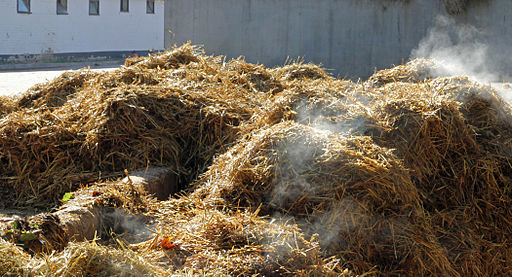
Perhaps he meant a manure field?
Glad to know I wasn’t the only one whose jaw dropped after reading that.
Most others also just expressed their disbelieve. What comes closest to an argument is:
scientists (economists, politicians) have been wrong before, thus climate science is not mature. Okay, maybe I am too generous calling that almost an argument. I hope I did not miss any arguments, the "discussion" was somewhat derailed by people arguing against the greenhouse effect. Also fitting to the level of the comments at Climate Etc. I have no idea how an improvement in scientific understanding should result from that blog.
What makes a scientific field mature?
So what is a "manure" scientific field?
Three important aspects are probably: mass, time and networking.
But let me first explain what maturity is not. Calling a field mature does not mean that no discoveries will be made any more, it also does not mean that predictions are perfect and confidence levels are zero. Science is not religion, if you cannot handle uncertainty, you should not be debating science.
Let's contrast a mature with a young science. For example the beginning of discovery of the greenhouse effect. From Wikipedia:
"The existence of the greenhouse effect was argued for by Joseph Fourier in 1824. The argument and the evidence was further strengthened by Claude Pouillet in 1827 and 1838, and reasoned from experimental observations by John Tyndall in 1859, and more fully quantified by Svante Arrhenius in 1896." These single scientists could easily have been completely wrong. The years indicate that they did not communicate with each other about the topic. There was thus no competition for who was smarter. At that time it could have happened that someone found that the arguments of Fourier were nice, but the observation do not show the effect. That the measurements of Tyndall were carefully performed, but his instrument does not measure what he thought it did. That there is a greenhouse effect, but contrary to the findings of Arrhenius CO2 is completely irrelevant. And at the time, it would have been possible that negative feedbacks are so strong, that any additional radiative forcing by CO2 does not influence the surface temperature. And a Galileo might have found a stupid calculation error in the works of any of these scientists.
Mass. There are thousands of climate researchers and in I just found 112,598 articles on the Web of Science about "global warming" or "climate change". These article will not all be studying climate change, but a large part will. That alone makes a stupid calculation errors nearly impossible. Having multiple people working on the same topic also provides a sparring partner to discuss and compete with.
The weight of the evidence is huge, not comparable to previous times the media or scientists called alarm or called for more research.
Networking. Mass allows some scientists to specialize. For example, some people work on radiative transfer for most of their career. They study the importance of various assumptions, try out various methods of solving a problem, solve various problems with radiative transfer (greenhouse effect, passive and active remote sensing) write textbooks, collaborate with scientists working on radiative transfer in other fields, build joint validation programs for radiative transfer codes, and so on. A specialist is less likely to make mistakes as a newby, the
networking weaves a scientific field into the the complete network of scientific theories, methods and tools. (Nothing against newbies, a growing science will have lots of them and they can help with fresh ideas.)
If the physical basis of climate change were found to be wrong, this would likely affect many other sciences via this network. Anything is theoretically possible, but this sure makes it much less likely. The first thing many climate change dissenters learn about is the greenhouse effect itself. Unfortunately many get stuck with this very well connected theory. It is much more likely to find problems with aspects that are specific to climatology, the climatological response of the oceans, vegetation and clouds, for example. What will happen with extreme weather, and all the various impacts? These are difficult questions, but they are not questions that are solved by one Galileo paper. If you want to be that guy, please have a look at such topics, not the greenhouse effect and make the "debate" at least a little more intelligent. Even better, take an objective look at these topics, that increases the chance you will contribute to our understanding of climate change.
Time. Time is important first of all as the amount of time a specialist spends on a topic. Secondly,
science takes place in the scientific literature. Performing a study, writing it up and getting it published can easily take a year or longer. While the main ideas might be known from conferences, an idea can only be fully tested after publication. And the response again easily needs a year.
Thus science takes time. Also creativity takes time. The longer no new idea turns out to change the main picture much, the less likely it becomes that that happens. And also for creativity mass is important, more people have more funky ideas.
How does a mature scientific field work?
Discoveries. That does not mean that no new discoveries are made. In my own field homogenization we have made spectacular progress the last decade.
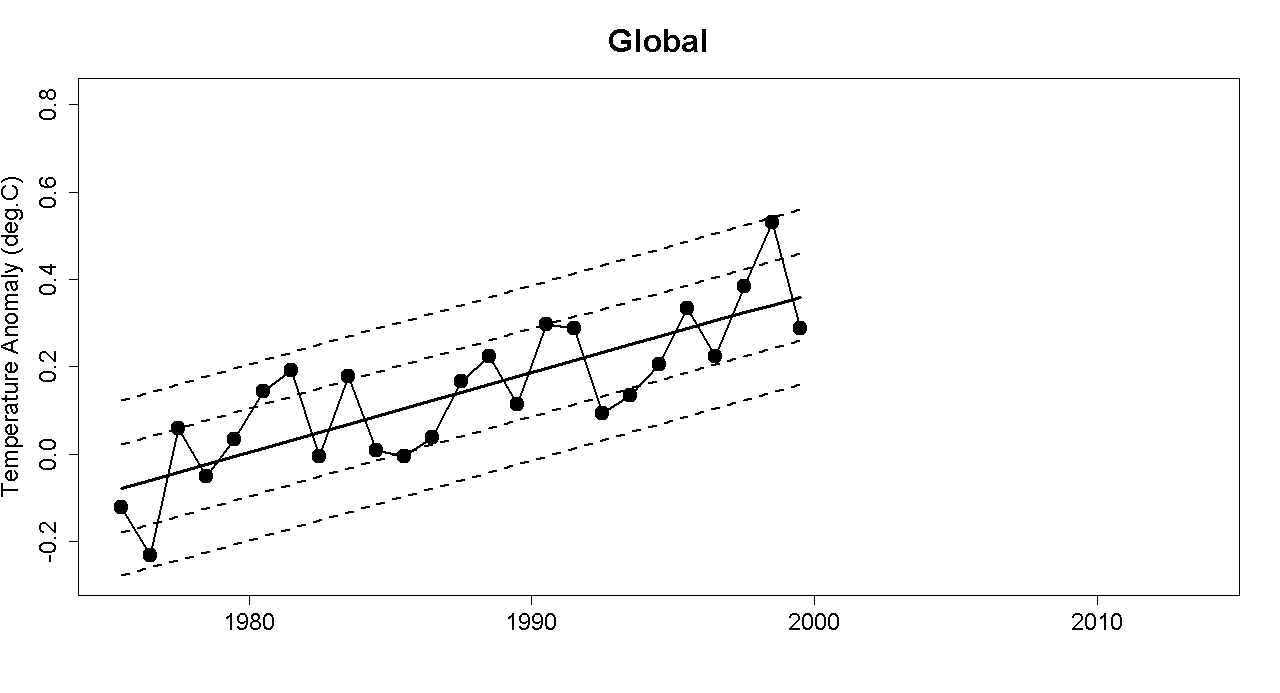
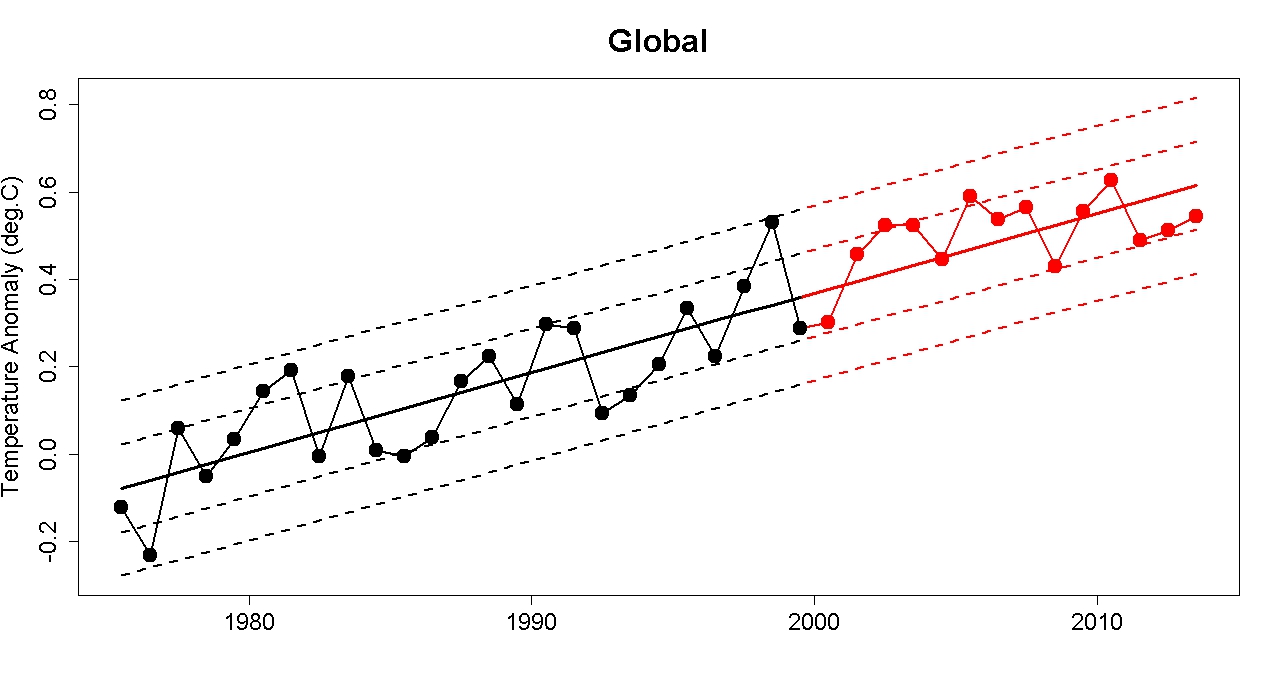
Modern homogenization methods are now twice as good as traditional ones. Better methods have increased scientific confidence that the temperature trend is robust, but did not change the trend much. (This may be different for daily data, used to study changes in extreme weather, where non-climatic changes are expected to be more important.)
While the homogenization of the annual means is a "manure" science, the homogenization of daily data is in its infancy. Some of my colleagues object to me calling annual homogenization mature, because they still have many ideas to improve it. I hope that after this post, people will understand that I do not see that as a contradiction. Science is never finished, but that does not mean that we know nothing.
Bias. In the beginning, when there is just one person or a few groups working on a problem, they may be tempted to exaggerate the importance of their problem. Most scientists are rather conservative when it comes to making strong claims, but scientists are also humans and some may be tempted by external incentives,
although disingenuous pseudo-skeptics like to exaggerate this problem. Calling something a problem helps attracting more people and funding. Exaggeration is relatively easy in this stage as the uncertainties are high and are high due to ignorance.
When a field gets larger, every speciality has an incentive to exaggerate the importance of their speciality. A solar physicist is tempted to claim it is the sun, but hindered by the evidence. I went into science to understand the world a little better and maybe to show off my skills. Were I driven by monetary incentives, as a naive economist might expect, I would be tempted to claim large uncertainties due to non-climatic changes, that would make my field more important. Even if Anthony Watts thinks otherwise,
it would be bad for my career to claim that climate data is fine. Making unscientific claims WUWT-style would hurt my career even more and take the fun out of being a scientist.
Because of the incentives of the solar physicist to claim that global warming is due to the sun and my incentive to claim it is non-climatic, the chance of a bias in the big picture is much reduced for a "manure" science. Our understanding will keep on improving and estimates will change, but
at this stage I would no longer expect any biases in the basic science: the changes will go in any direction.
Judith Curry likes the word
uncertainty. Towards other scientists she can claim that she intended it the way science uses the word: we do not know the exact value, it lies in a confidence range. It could be higher, it could be lower. To her audience that sounds like: they know nothing, they are not sure about climate change, maybe there is no problem after all. Curry's audience hears bias! And is shocked that someone dares to call climatology a mature science.
Let me close with an interesting tweet on the topic of terms used differently inside and outside the scientific world. (The figure comes from
Communicating the science of climate change by Richard Somerville and Joy Hassol. h/t Lars Karlsson)
* Some of the comments have been edited for readability.
** Tip: do not search for "mature" Flickr images.